


LiDAR
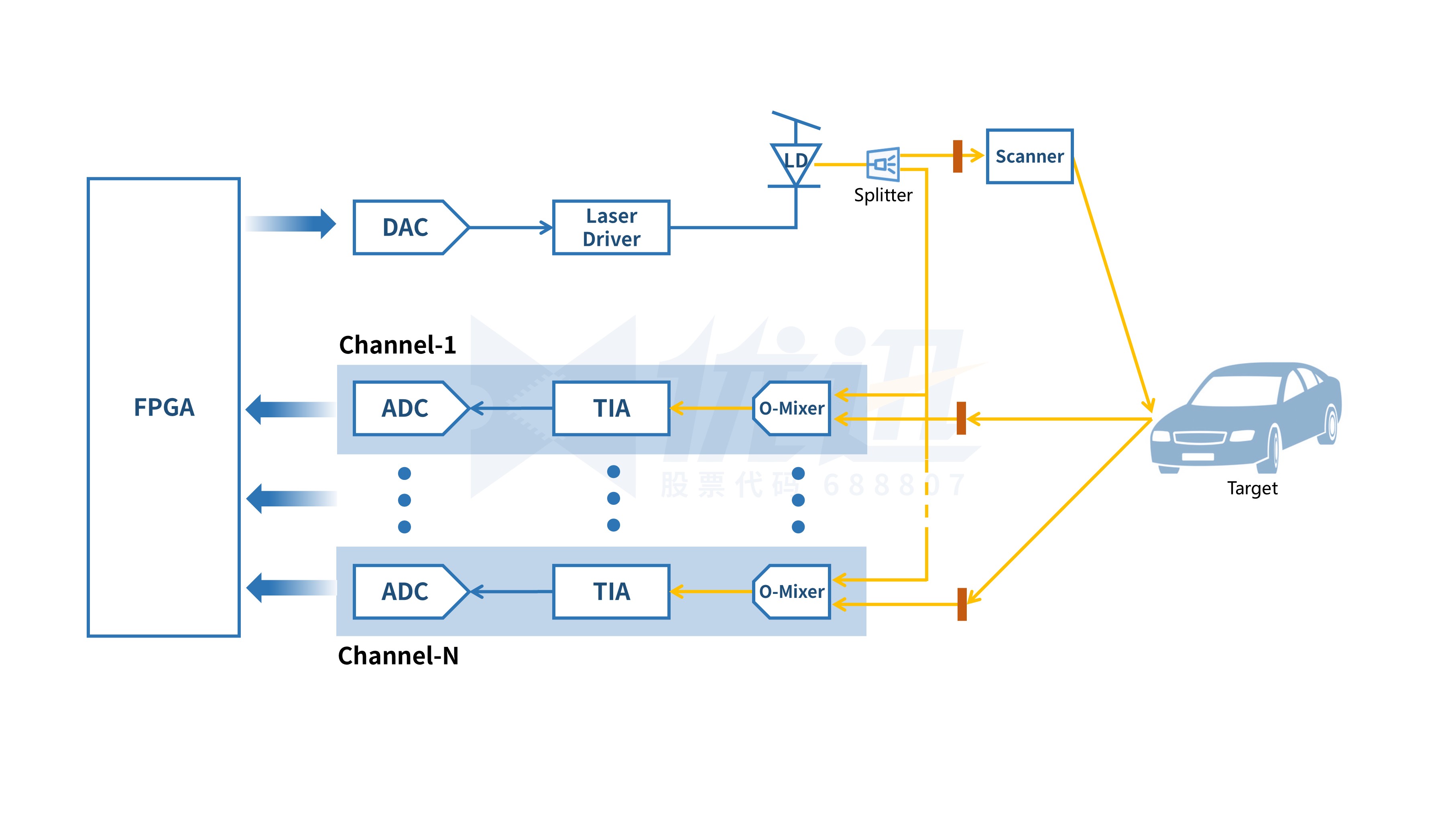
FMCW (Frequency-Modulated Continuous-Wave) LiDAR operates by emitting a continuous wave signal whose frequency varies linearly over time. Upon receiving the echo reflected from a target, the system mixes this echo with the local oscillator (LO) signal to generate an intermediate frequency (IF) signal. By analyzing the frequency shift of the IF signal, the target distance can be calculated; furthermore, leveraging the Doppler effect, the radial velocity of the target can also be precisely measured. This principle allows the signal processing flow to be highly compatible with digital chips, significantly reducing hardware complexity.
UX IC's FMCW LiDAR chipset calculates target distance and velocity based on the frequency difference between the echo and the transmitted signal, offering the advantage of simplified hardware processing. These chips are widely adopted in automotive radar and Advanced Driver-Assistance Systems (ADAS), supporting critical functions such as Blind Spot Detection (BSD) and Adaptive Cruise Control (ACC). Additionally, the solution proves effective in proximity sensing and gesture recognition applications.


